

Choosing a Subclass 820 Visa Lawyer: 2026 Australian Partner Visa Guide
Published 21 September 2026 · 15 min read
A successful onshore partner visa application isn't built on a random assortment of photos or generic checklists; it demands a coherent legal strategy. Engaging a qualified subclass 820 visa lawyer can be the critical factor that protects your application from evidentiary oversights, unexpected refusals, and lengthy processing delays.
You probably already feel the pressure of assembling years of de facto evidence, fearing that an overlooked detail could jeopardise your shared future in Australia. When standard Department assessment benchmarks can stretch across two years, securing dependable guidance is vital, yet distinguishing seasoned legal specialists from generic intermediaries often feels confusing and stressful.
In this guide, you'll discover how to evaluate, compare, and select an independent Australian immigration lawyer for your onshore Subclass 820 partner visa application. We break down the evidentiary standards Department decision-makers apply, clarify the procedural protections of formal legal representation, and explain how to connect with verified, independent practitioners across Sydney, Melbourne, Brisbane, Perth, Adelaide, and beyond.
Key Takeaways
• Understand the statutory evidentiary thresholds under Australian migration law to ensure your cohabitation and financial records withstand intensive Department scrutiny.
• Learn how to evaluate practising credentials and case history when choosing an independent subclass 820 visa lawyer for onshore representation.
• Distinguish between migration agents and legal practitioners, specifically regarding legal professional privilege and representation rights during complex appeals.
• Discover the structured documentation methods required to bundle genuine relationship evidence ahead of an initial legal consultation.
• Use Visas.com.au as an independent marketplace to compare vetted immigration lawyers across Australian capital cities and key offshore expatriate centres.
Table of Contents
• Why Complex Subclass 820 Partner Visas Demand Specialist Legal Expertise
• Evaluating a Subclass 820 Visa Lawyer: Key Selection Criteria
• Migration Agent vs Immigration Lawyer: Choosing the Right Partner Visa Advocate
• Preparing for Your Legal Consultation: Essential Questions and Evidence
• Connecting with Verified Independent Migration Professionals via Visas.com.au
Why Complex Subclass 820 Partner Visas Demand Specialist Legal Expertise
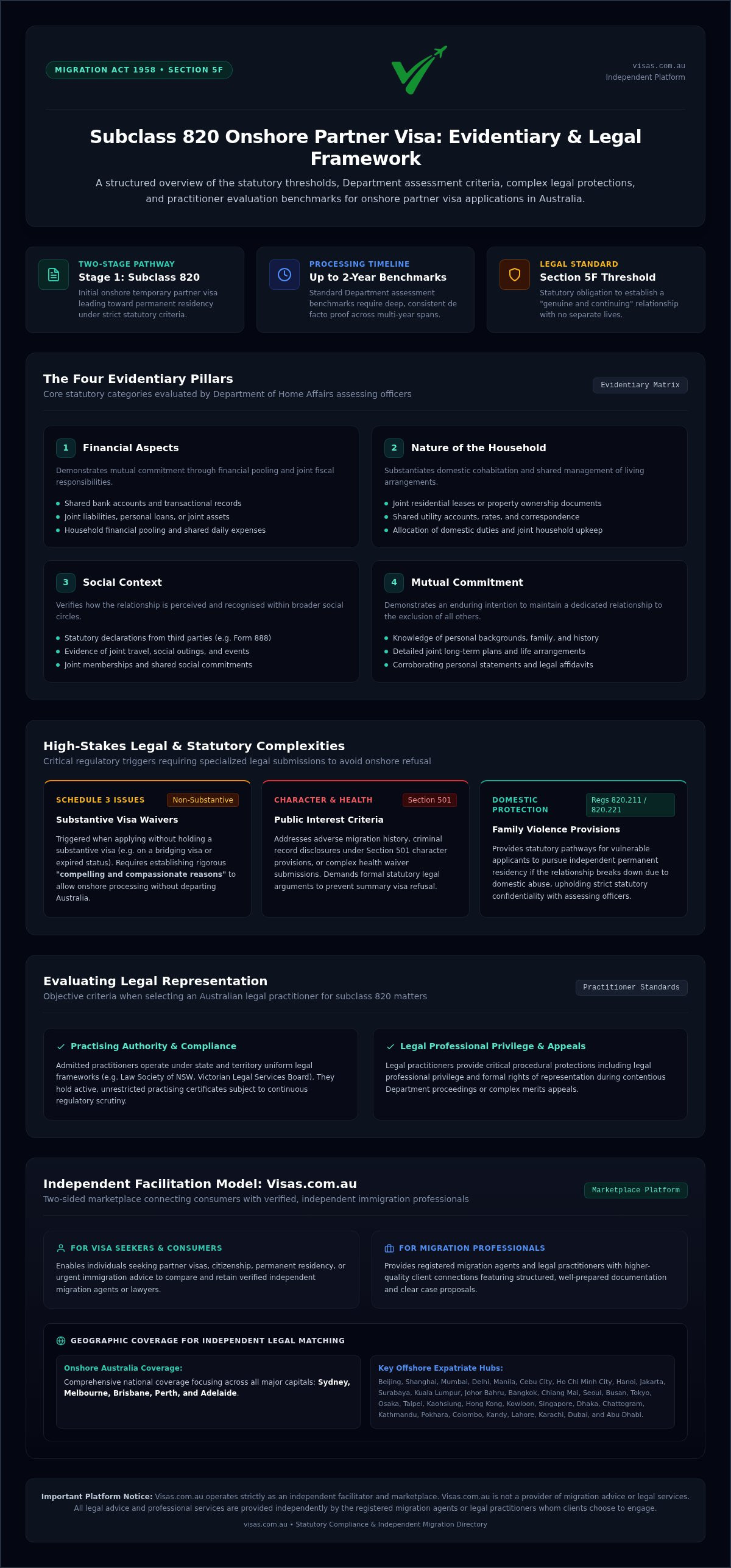
The onshore Subclass 820 partner visa represents the initial stage of a combined two-tier pathway toward Australian permanent residency. While many couples assume the process involves simple record collection, the Department of Home Affairs evaluates applications under strict statutory criteria set out in Section 5F of the Migration Act 1958. Assessing whether a relationship is genuine and continuing involves intensive officer scrutiny. Where gaps, anomalies, or complex immigration histories exist, retaining an independent subclass 820 visa lawyer ensures your claims are supported by rigorous statutory arguments rather than subjective assumptions.
Navigating Schedule 3 Issues and Substantive Visa Waivers
Lodging an onshore application without holding a substantive visa, such as being on an expired visa or bridging visa, immediately triggers Schedule 3 criteria. Under these provisions, you must establish "compelling and compassionate reasons" to waive these requirements. Independent legal practitioners analyse your circumstances against strict administrative standards, drafting persuasive submissions that articulate why your application should proceed onshore without forcing a departure from Australia.
Overcoming Deficiencies in the Four Evidentiary Pillars
Decision-makers assess partner applications across four distinct evidentiary pillars:
• Financial aspects: Shared bank accounts, joint liabilities, and household financial pooling.
• Nature of the household: Joint leases, utility accounts, and shared domestic responsibilities.
• Social context: Evidence from joint travel, social circles, and statutory declarations.
• Mutual commitment: Knowledge of personal backgrounds and long-term joint plans.
Short relationships or unconventional living arrangements often lack traditional documentation. A specialist subclass 820 visa lawyer helps structure detailed affidavits and corroborating statements, transforming fragmented proof into a coherent body of legal evidence.
Managing Health, Character, and Relationship Breakdown Complexities
Underlying legal complications demand formal representation. Complexities involving Public Interest Criteria, Section 501 character disclosures, or health waiver submissions require precise legal handling to avoid immediate refusals. Additionally, Australian migration regulations provide critical protections under family violence provisions (Regulations 820.211 and 820.221), allowing vulnerable applicants to pursue permanent status independently if a relationship ends due to domestic abuse. Qualified legal practitioners guide clients through these sensitive processes, maintaining statutory confidentiality while presenting robust evidence directly to assessing officers.
Evaluating a Subclass 820 Visa Lawyer: Key Selection Criteria
Marketing accolades and broad firm profiles rarely reveal whether a practitioner possesses genuine depth in onshore partner law. Because partner applications require tailored evidence rather than standard filing routines, you need an objective framework to assess prospective legal counsel. Selecting an independent subclass 820 visa lawyer requires looking beyond generic claims to verify practising authority, relevant case history, and clear retainer conditions.
Verifying Professional Credentials and Legal Practising Certificates
Australian immigration lawyers operate under state or territory legal profession uniform laws. Unlike unregistered offshore operators, admitted practitioners must hold an active, unrestricted practising certificate issued by a relevant statutory body, such as the Law Society of New South Wales or the Victorian Legal Services Board. Before formalising representation, review official guidance on engaging an Australian legal practitioner for immigration assistance. You should cross-check their standing on the public register of legal practitioners in their jurisdiction to verify there are no active disciplinary actions or practice restrictions against them.
Assessing Demonstrated Casework and Partner Stream Specialisation
General litigation experience does not automatically translate into migration proficiency. Subclass 820 matters demand an intimate knowledge of Departmental policy instructions and recent tribunal authorities. When vetting independent practitioners, consider these evaluation benchmarks:
• Casework volume: The proportion of their active caseload dedicated specifically to onshore partner visas.
• Tribunal litigation: Demonstrated experience appealing adverse decisions before the Administrative Review Tribunal (ART).
• Direct practitioner access: Confirmation that an admitted lawyer, rather than administrative support staff, personally reviews your evidentiary bundles and prepares your statutory declarations.
A specialist subclass 820 visa lawyer will readily explain their legal strategy for addressing evidentiary gaps, past visa refusals, or previous sponsorship histories.
Cost Structures, Retainer Agreements, and Scope Clarity
Consumer protections under Australian legal profession acts require lawyers to issue formal cost disclosure statements before engagement. A transparent retainer defines the exact scope of representation, clarifying whether the agreement covers Requests for Information (RFIs) or Natural Justice letters issued under Section 57 of the Migration Act 1958. For further guidance on fee structures and vetting standards, read our detailed guide on choosing an Australian immigration lawyer. To compare verified practitioners across Sydney, Melbourne, Brisbane, Perth, or Adelaide, you can create an enquiry online to evaluate independent proposals side by side.
Migration Agent vs Immigration Lawyer: Choosing the Right Partner Visa Advocate
Deciding between a Registered Migration Agent (RMA) and an Australian legal practitioner depends entirely on your relationship history and application risks. Both roles provide valuable immigration assistance, but their training, regulatory standards, and scope of legal representation differ substantially. Clarifying these distinctions ensures you match your Subclass 820 partner visa strategy to the appropriate level of professional advocacy.
Educational Foundations and Legal Professional Privilege
Immigration lawyers complete a Bachelor of Laws (LLB) or Juris Doctor (JD), undertake practical legal training, and gain formal admission to the Supreme Court of an Australian state or territory. Migration agents hold specialised tertiary qualifications in Australian migration law and maintain registration with the Office of the Migration Agents Registration Authority (OMARA). Under the Migration Amendment (Regulation of Migration Agents) Act 2020, dual registration ended; admitted legal practitioners are regulated exclusively by their state law society or legal practice board.
Crucially, only admitted lawyers offer Legal Professional Privilege (LPP). This common-law protection ensures client communications regarding legal advice remain strictly confidential and cannot be compelled for disclosure to government bodies. Non-lawyer agents cannot extend LPP over client files, making an independent subclass 820 visa lawyer essential whenever sensitive background disclosures arise.
Representation Powers Before the Tribunal and Federal Courts
Procedural reach represents another critical operational difference between these two professional pathways:
• Merits Review: Both migration agents and immigration lawyers can lodge merits review appeals and advocate before the Administrative Review Tribunal (ART).
• Judicial Review: Only qualified lawyers holding active practising certificates can represent clients in the Federal Circuit and Family Court of Australia (FCFCOA), Federal Court, or High Court of Australia.
If the Department refuses an onshore application, applicants face a strict, non-extendable statutory deadline of 21 calendar days to lodge an appeal with the ART. For deeper insight into licensing structures, read our comparison on evaluating migration professionals.
Decision Framework: When an Agent Suffices vs When a Lawyer Is Crucial
Reviewing the official Department of Home Affairs onshore partner visa guidelines reveals that couples with long-term cohabitation, shared property, and unblemished visa records can often rely safely on an experienced migration agent. Conversely, matters involving previous visa refusals, Section 48 considerations, character issues under Section 501, or complex Schedule 3 waiver applications warrant direct legal counsel. When substantial legal interpretation or prospective court litigation looms, engaging a dedicated subclass 820 visa lawyer gives your application comprehensive protection from initial submission through to final determination.
Preparing for Your Legal Consultation: Essential Questions and Evidence
Arriving at an initial legal consultation without organised documentation wastes billable time and obscures critical statutory risks. Because an onshore partner application turns on precise facts, presenting your history systematically allows prospective legal counsel to identify vulnerabilities immediately. A well-prepared relationship dossier gives an independent subclass 820 visa lawyer the exact materials required to formulate an effective lodgement strategy.
Structuring Your Relationship Timeline and Supporting Records
Transforming raw personal history into legally admissible evidence starts with chronological discipline. Prepare your background files using these structured categories:
• Chronological relationship summary: A concise timeline documenting your first introduction, decision to commit exclusively, cohabitation start dates, and significant future milestones.
• Financial records: Consecutive bank statements demonstrating routine shared transactions, joint utility commitments, or co-signed residential tenancy agreements.
• Supporting declarations: Draft statements from Australian permanent residents or citizens confirming the genuine nature of your domestic partnership.
If either partner previously resided in expatriate hubs like Singapore, Dubai, Hong Kong, or Kuala Lumpur, collate international movement records and historical lease agreements early. This ensures seamless continuity between overseas commitments and your onshore Australian domestic life.
Vital Questions to Screen Prospective Independent Counsel
Evaluating an advocate requires targeted questioning focused on process mechanics. Ask prospective counsel directly about their recent onshore caseload, including typical processing delays and their experience managing requests for further evidence. Confirm whether the admitted practitioner will personally draft your legal submissions or delegate tasks to junior support staff. For a structured vetting framework, consult our guide outlining 15 vital questions to ask a practitioner before committing funds.
Evaluating Practitioner Professionalism and Spotting Red Flags
Rigorous legal practitioners never guarantee visa grant outcomes or claim backchannel influence within the Department of Home Affairs. Be wary of any representative who promises expedited processing times or glosses over mandatory statutory criteria. A genuine specialist will candidly assess bridging visa transitions, outlining exactly when Bridging Visa A work rights activate once your current substantive visa ceases. Whether you reside in Sydney, Melbourne, Brisbane, Perth, or Adelaide, you can compare verified legal practitioners by submitting your details via our online enquiry portal to secure independent, vetted proposals.
Connecting with Verified Independent Migration Professionals via Visas.com.au
Single-firm websites inevitably funnel every enquiry into their own internal billing structure. Visas.com.au operates differently. As an independent connection platform, the service allows you to compare multiple vetted practitioners side by side. Rather than providing legal advice directly, the platform serves as a secure gateway, matching applicants with qualified independent immigration lawyers and registered migration agents who assess cases objectively.
How the Independent Marketplace Model Empowers Consumers
Navigating the legal market shouldn't involve endless repetitive intake forms. By submitting a structured enquiry detailing your relationship background once, you receive transparent proposals directly from independent practitioners. This marketplace structure gives you full autonomy to evaluate cost proposals, compare professional backgrounds, and decide who represents your interests without facing sales pressure or intermediary lock-in fees.
Every professional listed on the platform undergoes rigorous professional verification. This vetting process confirms active practising certificates with relevant state legal boards or current OMARA registration, ensuring the independent subclass 820 visa lawyer you choose holds full statutory authority to represent your matter.
Nationwide and Global Connectivity for Partner Visa Applicants
Partner migration frequently spans multiple jurisdictions before coalescing onshore in Australia. The platform connects consumers with independent practitioners across all major Australian cities, including Sydney, Melbourne, Brisbane, Perth, and Adelaide. For cross-border relationships, verified professionals also assist applicants transitioning from major overseas expatriate centres, such as Beijing, Shanghai, Mumbai, Delhi, Manila, Cebu City, Ho Chi Minh City, Hanoi, Jakarta, Surabaya, Kuala Lumpur, Johor Bahru, Bangkok, Chiang Mai, Seoul, Busan, Tokyo, Osaka, Taipei, Kaohsiung, Hong Kong, Kowloon, Singapore, Dhaka, Chattogram, Kathmandu, Pokhara, Colombo, Kandy, Lahore, Karachi, Dubai, and Abu Dhabi.
Migration practitioners seeking well-prepared client briefs and structured relationship dossiers can also learn more about our network for professionals.
Taking the Next Step Towards Securing Your Future Together
Your visa journey demands professional clarity and total transparency. Review candidate credentials, assess practitioner communication styles, and select the independent advocate best equipped to assemble your case. All migration advice and representational legal services are delivered independently by the chosen practitioner. To get started, compare verified migration professionals and retain a dedicated subclass 820 visa lawyer with confidence.
Secure Your Partner Visa Journey with Independent Legal Guidance
Navigating the evidentiary hurdles of an onshore partner application requires strategic precision. From establishing the four evidentiary pillars under Section 5F to resolving complex Schedule 3 waiver criteria, the right advocate protects your shared future. Retaining a dedicated subclass 820 visa lawyer ensures your relationship timeline is fortified with legal professional privilege, clear procedural safeguards, and rigorous statutory analysis.
Visas.com.au empowers couples across Sydney, Melbourne, Brisbane, Perth, and Adelaide to take control of this pivotal decision. As an independent marketplace, the platform enables you to evaluate multiple transparent proposals side by side without sales pressure. Every listed legal practitioner undergoes thorough verification to confirm an active Australian practising certificate, while all legal advice and migration representation are delivered independently by your chosen practitioner.
Take the uncertainty out of your onshore migration process. Connect with verified independent partner visa lawyers today to evaluate tailored proposals and build your shared life in Australia on solid legal footing.
Frequently Asked Questions
Can an independent Subclass 820 visa lawyer guarantee my partner visa approval?
No legal representative can lawfully guarantee a visa outcome. The Department of Home Affairs retains sole statutory authority to assess and decide onshore partner visa applications under the Migration Act 1958. An experienced subclass 820 visa lawyer builds the strongest possible evidentiary case, identifies legal risks early, and prevents procedural errors, but any practitioner promising guaranteed approval breaches professional conduct rules.
How does an immigration lawyer differ from a registered migration agent for partner visas?
Immigration lawyers hold formal law degrees and practising certificates regulated by state legal practice boards, whereas migration agents are registered with OMARA. Admitted lawyers can represent you in federal court litigation and provide statutory legal professional privilege, keeping your strategic case discussions confidential. Migration agents handle administrative lodgements and merits review effectively, but cannot represent you before judicial bodies if legal appeals escalate.
What happens if my Subclass 820 visa application is refused by the Department?
If your onshore application is refused, you have a strict statutory deadline of 21 calendar days from notification to lodge a review. Appeals are heard by the Administrative Review Tribunal (ART), which replaced the former AAT in late 2024. Engaging an independent subclass 820 visa lawyer immediately helps evaluate whether evidentiary gaps or jurisdictional errors caused the decision, allowing you to prepare fresh arguments before your appeal rights lapse.
Do I need an immigration lawyer if my partner and I have lived together for over twelve months?
Meeting the twelve-month cohabitation threshold satisfies only one baseline requirement for de facto couples. Decision-makers assess your shared life across all four legal pillars: financial, household, social, and mutual commitment. If you have clear, continuous joint records and no adverse immigration history, self-lodging or using an agent might suffice. However, if your history contains periods of separation, previous sponsorships, or visa cancellations, an independent legal practitioner provides essential security.
Can a lawyer help if I am currently unlawful or subject to Section 48 bar restrictions?
Yes, independent lawyers routinely handle complex onshore status complications. While Section 48 prevents individuals with refusals from lodging most visas onshore, partner visas remain specifically exempt under Regulation 2.12. If you are unlawful or on a bridging visa, you must satisfy Schedule 3 criteria or request a formal waiver. A lawyer drafts detailed legal submissions proving compelling and compassionate reasons to ensure the Department considers your onshore application.
How does Visas.com.au vet the independent migration lawyers on its platform?
Visas.com.au conducts a structured verification process before any practitioner connects with clients. The platform confirms that every listed lawyer holds an active, unrestricted practising certificate with their respective Australian state or territory legal regulator, or active OMARA registration for agents. While Visas.com.au facilitates transparent comparisons and enquiry management, it does not provide legal advice; all professional services are delivered independently by the chosen practitioner.
Can I use Visas.com.au if my sponsoring partner is in Australia but I am currently overseas?
Yes, the platform connects couples across international boundaries. Whether your partner is based in Sydney, Melbourne, Brisbane, Perth, or Adelaide, and you reside in approved hubs like Singapore, Manila, Dubai, Mumbai, or Kuala Lumpur, you can submit an enquiry together. Independent Australian practitioners can evaluate whether an onshore Subclass 820 pathway or an offshore Subclass 309 application best aligns with your relocation timeline and current visa status.
Disclaimer
Nothing in the article is intended to be providing any migration or legal advice whatsoever and this website Visas.com.au is a marketplace and does not itself provide migration advice or legal services. All advice and professional services are provided independently by the migration professionals you choose to engage.
Frequently asked questions
This article is general information only and is not migration, legal or personal advice. Visas.com.au is a marketplace and does not provide migration or legal services. For advice about your circumstances, engage a registered migration agent or Australian immigration lawyer.