

Bridging Visa Help Australia: Complete 2026 Guide to Rights, Subclasses, and Expert Support
Published 24 September 2026 · 15 min read
With active bridging visas peaking at 415,000 and substantive visa processing times stretching to an average of 8.5 months, thousands of visa holders find themselves living in prolonged administrative limbo. If you are searching for clear bridging visa help Australia wide, you already know the real anxiety that accompanies these delays. The constant threat of work restrictions, unexpected travel bans, or accidentally lapsing into unlawful status can leave your future feeling entirely out of your hands.
It is completely understandable to feel cautious when trying to decipher the strict conditions attached to different visa subclasses. This comprehensive guide clarifies your fundamental rights, explains how to avoid inadvertent compliance breaches, and shows you how to connect with vetted Australian migration professionals for independent, specialist advice. Below, we examine work and travel permissions across key subclasses, outline critical compliance deadlines, and provide a clear roadmap to keep your lawful stay secure.
Key Takeaways
• Understand how Australian bridging visas maintain your lawful non-citizen status while your substantive application is under departmental review.
• Compare the distinct rules governing BVA, BVB, BVC, and BVE subclasses, particularly regarding domestic work rights and travel permissions.
• Learn why departing Australia without an approved Bridging Visa B revokes your right to return, and how to apply for travel approval before booking flights.
• Identify the necessary steps following a visa refusal, including the strict timeframes for lodging an appeal with the Administrative Review Tribunal.
• Discover how to source independent bridging visa help Australia wide by comparing vetted, registered migration agents and legal practitioners across Sydney, Melbourne, Brisbane, Perth, and Adelaide.
Table of Contents
• Understanding Australian Bridging Visas: What They Are and Why Lawful Status Matters
• The Bridging Visa Hierarchy: Comparing Subclasses BVA, BVB, BVC, and BVE
• Managing Bridging Visa Conditions: Work Rights, Financial Hardship, and Travel Limits
• Complex Bridging Visa Scenarios: Refusals, Appeals, and Unlawful Status
• How to Access Independent Bridging Visa Help Across Australia in 2026
Understanding Australian Bridging Visas: What They Are and Why Lawful Status Matters
A bridging visa functions as a temporary legal mechanism designed to bridge the gap between substantive visas. Under the Migration Act 1958, any non-citizen physically present in the country must hold a valid visa to remain a lawful non-citizen. Without one, an individual immediately becomes an unlawful non-citizen, facing potential detention or mandatory removal. While bridging visas provide lawful status, holding one does not guarantee that your substantive application will succeed, nor does it confer permanent residency rights on its own.
Applicants often assume that all bridging permissions operate identically. In reality, some are granted automatically when you lodge a valid onshore application, whereas others require separate formal applications with strict evidentiary thresholds. To understand how these mechanisms fit into the broader statutory framework, reviewing the Visa policy of Australia provides useful context on how temporary permissions align with national immigration objectives.
The Core Purpose of Bridging Visas in Australia
Bridging visas preserve your legal presence while the Department of Home Affairs assesses your substantive paperwork. Maintaining unbroken lawful status is critical. An unlawful period can trigger severe integrity penalties, such as Public Interest Criterion (PIC) 4020 exclusions, which can enforce three-to-ten-year re-entry bans for providing misleading information or failing to regularise status. Additionally, if an application faces an adverse outcome, these visas serve as the legal anchor linking you to formal review proceedings before the Administrative Review Tribunal.
When Does a Bridging Visa Actually Take Effect?
Timing often causes intense confusion for temporary visa holders. The transition sequence follows specific legal rules:
• Dormant state: When granted while your current substantive visa (such as a student, working holiday, or visitor visa) remains active, your bridging visa sits dormant in the background.
• Activation point: The bridging visa only takes effect the exact moment your substantive visa ceases.
• No dual-visa overlap: You cannot hold two operational visas simultaneously. The conditions of your substantive visa govern your rights until its final expiry date.
Misinterpreting these activation dates can lead to unintentional breaches of work or study restrictions. Securing tailored bridging visa help Australia wide allows you to compare quotes from verified migration agents and immigration lawyers. Engaging independent specialists ensures your transition timeline protects your status throughout Sydney, Melbourne, Brisbane, Perth, and Adelaide.
The Bridging Visa Hierarchy: Comparing Subclasses BVA, BVB, BVC, and BVE
Australia’s bridging framework is strictly hierarchical. Your current immigration status at the exact moment of application dictates which subclass you receive. While the official list of Australian visas documents each subclass separately, viewing them side by side reveals significant operational differences in daily rights and international mobility.
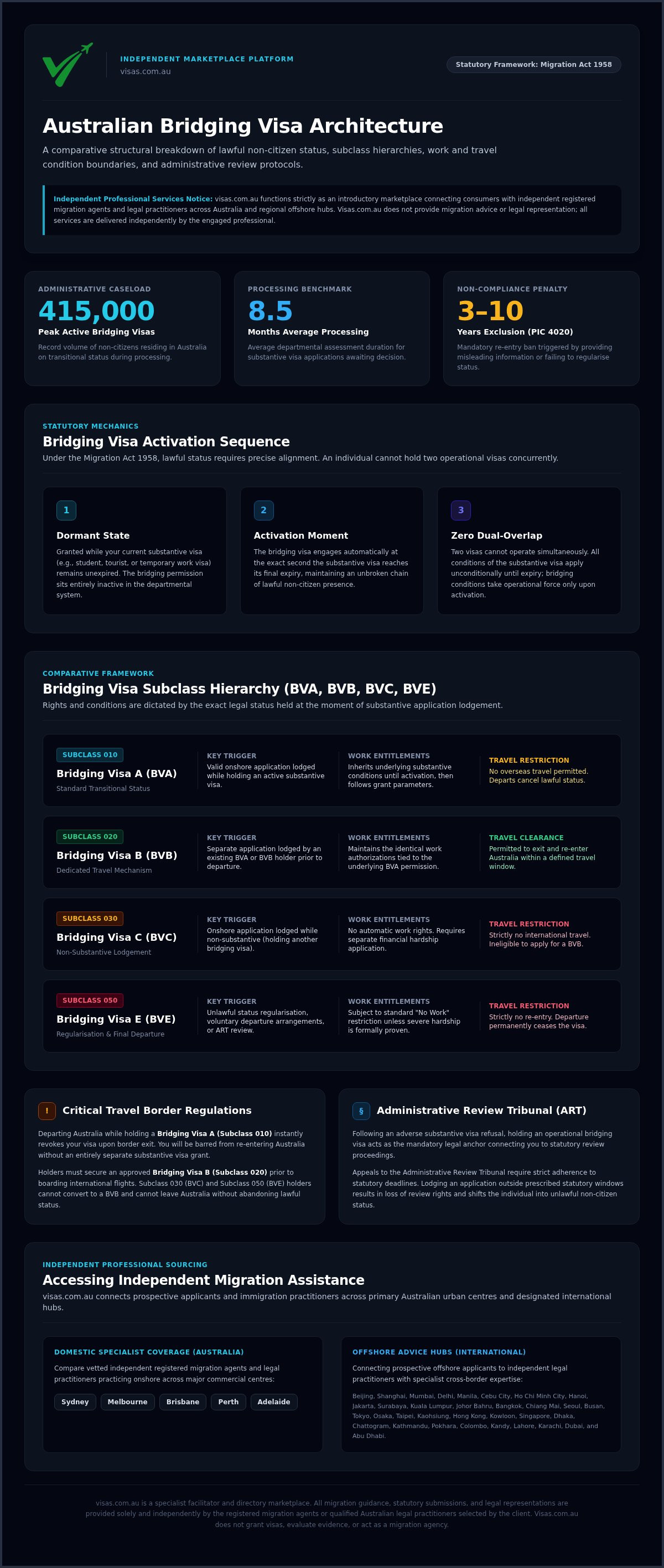
| Subclass | Key Trigger | Work Entitlements | Travel Rights |
|---|---|---|---|
| BVA (010) | Valid onshore application while substantive | Inherits substantive visa conditions | No overseas travel permitted |
| BVB (020) | Separate application by BVA/BVB holder | Maintains underlying BVA conditions | Permitted within specified travel window |
| BVC (030) | Application lodged while non-substantive | No automatic work rights (requires proof) | Strictly no international travel |
| BVE (050) | Unlawful status, departure, or ART appeal | Generally no work rights (hardship application) | Strictly no international travel |
Bridging Visa A (Subclass 010) vs. Bridging Visa B (Subclass 020)
Lodge a valid substantive application while holding a valid substantive visa, and you receive a BVA. It ensures seamless lawful presence. However, departing Australia on a BVA instantly extinguishes the visa at the border, leaving you stranded overseas with no automatic right of return. If you need to travel internationally for personal, family, or professional reasons, you must formally apply for a Subclass 020 (BVB) via ImmiAccount before leaving. You must wait for departmental approval before boarding any flight.
Bridging Visa C (Subclass 030) and Bridging Visa E (Subclass 050)
The lower tiers carry far tighter constraints. Subclass 030 is issued if your substantive visa lapsed before lodging your new application. It never allows overseas travel, and work rights are not automatic. Subclass 050 functions as a final safety net for unlawful non-citizens regularising their affairs or preparing departure. BVEs routinely carry strict reporting conditions at departmental offices, residential address tracking, and complete work prohibitions unless severe financial hardship is formally substantiated.
Misidentifying where you sit within this hierarchy can jeopardise both your employment and your long-term residency. If you are uncertain about your visa allocation or travel permissions, sourcing reliable bridging visa help Australia wide gives you direct access to independent, vetted specialists across Sydney, Melbourne, Brisbane, Perth, and Adelaide.
Managing Bridging Visa Conditions: Work Rights, Financial Hardship, and Travel Limits
Every bridging visa grant notice lists explicit legal conditions that dictate your daily life. Among the most restrictive is Condition 8101 (No Work), alongside Condition 8503 (No Further Stay), which limits your ability to lodge another substantive application while remaining in the country. Breaching these terms is dangerous. Unauthorised employment breaches your legal obligations, leading directly to visa cancellation, mandatory detention, and severe obstacles for any permanent residency ambitions.
Applying for Removal of 'No Work' Conditions
If your visa carries Condition 8101, you cannot simply begin working out of necessity. You must submit a formal application to the Department of Home Affairs to request work rights by establishing a compelling need to work based on financial hardship. Departmental decision-makers apply strict evidentiary standards to these requests. Asserting high living costs without corroboration results in immediate refusal.
To construct a viable submission, applicants generally compile a comprehensive evidentiary portfolio:
• Itemised personal budgets: A transparent ledger contrasting essential living expenses against all incoming funds.
• Consecutive bank statements: Three to six months of statements demonstrating depleted savings and an inability to meet basic living costs.
• Arrears documentation: Overdue rental notices, utility default warnings, or deferred medical bills showing immediate distress.
• Third-party verification: Statutory declarations from family or community groups confirming that external financial assistance has ceased.
Engaging an independent registered migration agent or immigration lawyer to structure this evidence ensures your application meets departmental standards, saving months of administrative delay.
Leaving Australia on a Bridging Visa: Crucial BVB Planning
International travel requires meticulous procedural timing. The Department of Home Affairs does not automatically grant travel permissions. Subclass 020 (BVB) grants specify a defined travel window with hard start and finish dates. If you remain outside Australia after midnight on the specified expiry date, your bridging visa ceases instantly. You will be stranded offshore with no legal mechanism to re-enter, which may simultaneously compromise your pending substantive visa application.
Never purchase non-refundable flight tickets before receiving official written confirmation of your BVB grant. Processing intervals vary, so early lodgement remains essential. If you face unexpected overseas obligations, accessing specialist bridging visa help Australia wide connects you with independent professionals across Sydney, Melbourne, Brisbane, Perth, and Adelaide who can review your travel window and preserve your pathway.
Complex Bridging Visa Scenarios: Refusals, Appeals, and Unlawful Status
When the Department of Home Affairs refuses a substantive visa application, your active bridging visa does not expire instantly. Under standard migration provisions, your bridging permission generally remains active for 35 calendar days following the refusal notification. However, an adverse decision instantly triggers the Section 48 bar of the Migration Act. This statutory restriction severely limits your capacity to lodge another onshore substantive visa, blocking common alternative pathways while you remain in Australia.
Substantive Visa Refusal: Preserving Status via Tribunal Review
To preserve your lawful standing, you can seek a review through the Administrative Review Tribunal (ART). Submitting a valid review application within the strict statutory window, usually 21 or 28 days depending on the notification method, automatically keeps your bridging visa alive while the appeal proceeds. The ART cannot grant extensions for late lodgements. Retaining an independent immigration lawyer ensures your grounds for appeal address specific legal errors made by departmental delegates, giving you the strongest possible case during hearings.
Overcoming Unlawful Status and Resolving Departure Gracefully
A persistent myth circulating among visa holders is the existence of an automatic 28-day grace period. In reality, Australian migration law recognises no such buffer. The exact moment a visa ceases without another application on foot, you become an unlawful non-citizen subject to mandatory detention under Section 189.
For individuals caught in unlawful status, resolving matters requires a clear, deliberate sequence:
• Proactive engagement: Contacting the Community Status Resolution Service (CSRS) voluntarily before immigration compliance teams intervene.
• Securing a Bridging Visa E: CSRS engagement allows you to regularise your presence through a Subclass 050 visa while planning next steps.
• Mitigating exclusions: Leaving Australia unlawfully or remaining non-substantive for more than 28 days triggers mandatory three-year re-entry exclusions under Public Interest Criterion (PIC) 4014.
Managing these complex scenarios demands professional precision. If your visa has been refused or has already lapsed, secure specialist bridging visa help Australia wide. Connecting with verified, independent migration agents and legal practitioners across Sydney, Melbourne, Brisbane, Perth, and Adelaide ensures your case is handled with the care and urgency it requires.
How to Access Independent Bridging Visa Help Across Australia in 2026
Resolving bridging visa difficulties demands seasoned technical expertise. Australian migration regulations change frequently, leaving little room for procedural errors. Seeking reliable bridging visa help Australia wide allows you to address status ambiguities before they trigger irreversible compliance actions. However, identifying the right professional support depends entirely on the nature of your immigration matter.
Registered Migration Agents vs. Immigration Lawyers: Selecting the Right Support
Understanding the distinction between registered migration agents and Australian legal practitioners ensures you engage the correct specialist:
• Registered Migration Agents: Regulated by the Office of the Migration Agents Registration Authority (OMARA), these practitioners handle core visa lodgements, departmental communications, work rights applications, and straightforward Administrative Review Tribunal matters.
• Immigration Lawyers: Holding current legal practicing certificates, these practitioners possess broader legal training. They represent clients before the Federal Circuit and Family Court of Australia, advise on complex statutory questions, and provide client legal privilege for sensitive compliance matters.
Always verify registration credentials to avoid unaccredited onshore operators or rogue offshore operators. Independent practitioners must hold current OMARA registration or state law society admission.
Connecting with Independent Australian Visa Specialists
Visas.com.au operates purely as an online marketplace connecting visa seekers with vetted Australian migration specialists. The platform does not give immigration advice, file visa applications, or act as a law firm. All professional consultations, legal strategies, and formal representations are delivered completely independently by the registered professionals you decide to instruct.
The platform streamlines how you compare support across Australia:
• Strict vetting: Every specialist on the platform undergoes independent credential verification to confirm active OMARA or legal practicing status.
• Multi-quote comparison: Post your requirements to receive independent proposals, allowing you to compare service scopes and fee structures transparently.
• Broad coverage: Connect with accredited experts based across Sydney, Melbourne, Brisbane, Perth, and Adelaide, as well as serving offshore applicants from major hubs such as Singapore, Manila, and Delhi.
Addressing bridging visa complications early safeguards your pathway. You can review and compare independent professional options by registering on Visas.com.au to protect your lawful standing with complete peace of mind.
Take Control of Your Australian Visa Pathway
Staying lawful while waiting on departmental outcomes is essential for your future in Australia. Whether you need to transition between subclasses, request work rights due to financial hardship, or plan essential overseas travel, managing your conditions carefully prevents costly re-entry exclusions and unexpected compliance issues.
When unexpected complications arise, obtaining reputable bridging visa help Australia wide gives you clarity and control. Sourcing independent legal guidance early ensures your deadlines are met, your evidence is properly prepared, and your appeal rights remain fully protected.
Visas.com.au provides an independent platform where you can compare transparent proposals from verified migration agents and immigration lawyers across Sydney, Melbourne, Brisbane, Perth, and Adelaide. Take the next step to protect your stay. Connect with verified Australian migration experts today and move forward with total confidence.
Frequently Asked Questions
Can I work in Australia while on a bridging visa?
Whether you can work depends on your bridging subclass and your prior substantive visa conditions. A Bridging Visa A (BVA) typically inherits the work entitlements of your previous visa. Subclasses like BVC and BVE generally impose Condition 8101 (No Work) by default. If your visa prohibits employment, you must lodge a separate departmental application showing severe financial hardship to request work permission legally before beginning any job.
How do I travel outside Australia and return on a bridging visa?
You can only travel abroad and re-enter lawfully if you hold an approved Bridging Visa B (Subclass 020). Standard bridging visas such as BVA, BVC, or BVE immediately cease if you cross the Australian border outwards. Always lodge your BVB application online via ImmiAccount well in advance of departure, and never leave Australia before the Department of Home Affairs officially grants your travel window.
What happens to my bridging visa if my main visa application is refused?
A substantive refusal does not cancel your bridging visa on the spot. Under Australian migration regulations, your bridging visa usually continues for 35 calendar days after the refusal notification date. If you lodge a timely review with the Administrative Review Tribunal (ART) within your specified statutory deadline, your bridging visa remains active, preserving your lawful non-citizen status throughout the entire appeals process.
How long does an Australian bridging visa remain valid?
A bridging visa has no standard fixed duration. It generally remains valid until a formal decision is handed down on your substantive visa application, or until a specified date if you hold a Bridging Visa B. If an application is refused, the visa generally lasts for 28 to 35 days, or continues operating until an Administrative Review Tribunal appeal is formally concluded.
Can I apply for a Medicare card while holding a bridging visa?
Yes, you can access Medicare on a bridging visa if you meet specific eligibility criteria. You must have lodged a valid application for an onshore permanent substantive visa or a partner visa that confers Medicare rights. You will need to present your valid bridging visa grant notice, your current passport, and the Department's formal acknowledgement letter at a Services Australia service centre.
What should I do if my substantive visa expires before my bridging visa is granted?
If your substantive visa expires without an active bridging visa in place, you become an unlawful non-citizen immediately. Contact the Department's Community Status Resolution Service (CSRS) right away to regularise your stay through a Bridging Visa E. Obtaining professional bridging visa help Australia wide ensures you quickly understand your options, avoid detention risks, and work to resolve your lawful status without compounding three-year re-entry exclusions.
Why should I use a marketplace to find bridging visa help in Australia?
Using an independent marketplace to source bridging visa help Australia wide allows you to compare transparent proposals from independently registered migration agents and immigration lawyers across Sydney, Melbourne, Brisbane, Perth, and Adelaide. Because Visas.com.au acts strictly as a neutral connection facilitator rather than an advice provider, you maintain complete control when choosing the right independent professional for your specific visa needs.
Disclaimer
Nothing in the article is intended to be providing any migration or legal advice whatsoever and this website Visas.com.au is a marketplace and does not itself provide migration advice or legal services. All advice and professional services are provided independently by the migration professionals you choose to engage.
Frequently asked questions
This article is general information only and is not migration, legal or personal advice. Visas.com.au is a marketplace and does not provide migration or legal services. For advice about your circumstances, engage a registered migration agent or Australian immigration lawyer.